
Carbon fibre tow and yarn
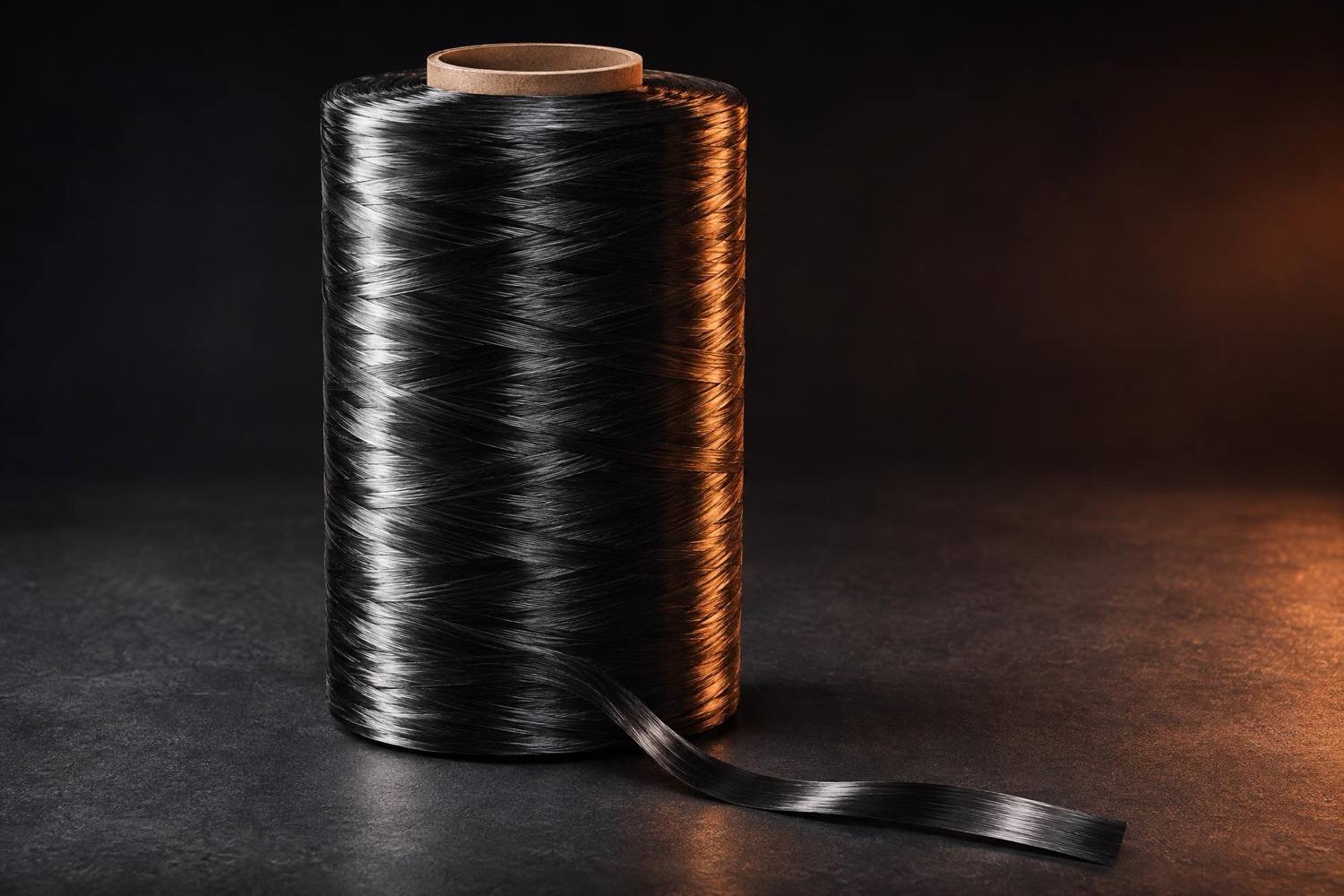
Raw carbon fibre tow and yarn, supplied on spools for companies that convert fibre themselves. Karwon Composites supplies tow for weaving, braiding, filament winding, pultrusion and chopped fibre use across Dubai, Abu Dhabi, Sharjah and the wider UAE, with documentation requirements agreed at quotation stage.
Specification
| Property | Typical value |
|---|---|
| Form | Continuous carbon fibre tow and yarn |
| Supply | On spools |
| Tow sizes | 3K, 6K, 12K |
| Fibre grades | T300, T700, T800; high modulus M40J, M55J |
| Sizing | Matched to your resin system, confirmed per order |
| Spool size | Quoted on enquiry |
What carbon fibre tow is
Tow is carbon fibre in its rawest commercial form: thousands of continuous filaments gathered into a single flat bundle and wound onto a spool. Everything else in the carbon range starts here. Fabric is tow that has been woven or stitched, rod and profile are tow pulled through resin and a die, and prepreg is tow or fabric with the resin already in it.
Yarn is the word used when the bundle is handled as a thread for textile processes such as weaving and braiding. In day to day buying the two words overlap, so state the grade and the tow size and the description takes care of itself.
Buying tow makes sense when you run the converting process yourself. If you need cloth, section or laminate, the finished form is usually the shorter route.
What the K count means
The K count is the number of filaments in the bundle, counted in thousands. A 3K tow has about three thousand filaments, a 6K tow about six thousand and a 12K tow about twelve thousand.
A lower K count gives a finer bundle. It weaves into a tighter, smaller pattern, follows detail more closely and suits thin laminates and visible surfaces. A higher K count gives a heavier bundle that lays down fibre faster, which suits winding, pultrusion and larger structural work.
The K count describes the size of the bundle, not the quality of the fibre. The fibre grade is a separate choice, and the two are specified together.
What tow is used for
Five downstream processes, each of which takes the same raw material somewhere different.
Weaving
Tow is run as warp and weft on a loom to make plain, twill and satin cloth. Finer tow gives the tighter cosmetic weaves.
Braiding
Tow is interlaced around a mandrel to make sleeves and tubular preforms that follow a changing section without a seam.
Filament winding
Tow is drawn through resin and wound onto a rotating mandrel at set angles, the usual route to pressure vessels, pipes and tubes.
Pultrusion
Many tows are pulled together through a resin bath and a heated die to form rod, strip and constant section profile.
Chopped fibre
Tow is cut to short lengths for moulding compounds and for the chopped fibre used in forged carbon.
Tell us the process you are running. It decides the tow size, the sizing and the spool format we point you to.
What to send us when you ask for a quote
Four things let us quote tow in one pass: the fibre grade, the K count, the spool size your equipment takes and the quantity.
Add the process you are running and the resin system you use, because the sizing on the fibre has to be compatible with the resin. If you are matching an existing material, send its specification rather than describing it.
Origin is specified per order rather than assumed, so say if your project restricts it. Documentation requirements are agreed at quotation stage.
Grade, tow size, sizing and spool format are confirmed against your process at quotation stage.
Where it is used
Weaving and textile conversion
Fibre for looms turning tow into woven reinforcement.
Braided sleeves and preforms
Tubular reinforcement made to follow a part rather than be cut and darted around it.
Filament wound vessels, pipes and tubes
Fibre wound at controlled angles, where the winding pattern is the structural design.
Pultruded rod and profile
Continuous tow pulled through a die into constant section members.
Chopped fibre and moulding compounds
Tow cut short for compression moulded parts and compounds.
Common questions
What is carbon fibre tow?
Tow is a bundle of continuous carbon filaments gathered together and wound onto a spool. It is the raw form of carbon fibre that weaving, braiding, filament winding and pultrusion all start from.
What does 3K, 6K or 12K mean?
It is the number of filaments in the bundle, in thousands. 3K is about three thousand filaments, 6K about six thousand and 12K about twelve thousand. A lower count gives a finer bundle, a higher count lays down fibre faster. It describes bundle size, not fibre quality.
What is the difference between carbon fibre tow and yarn?
In practice the terms overlap. Tow describes the filament bundle itself, and yarn is the word used when it is handled as a thread in textile processes such as weaving and braiding. State the fibre grade and the K count and the requirement is clear either way.
Which fibre grades is tow supplied in?
Standard grades T300, T700 and T800, and high modulus grades M40J and M55J. Tell us the process and what the finished part has to do, and we will recommend a grade rather than the most expensive one.
What do you need to quote carbon fibre tow?
The fibre grade, the K count, the spool size and the quantity. The process you are running and the resin system help as well, because sizing compatibility is confirmed against them.
Do you supply carbon fibre tow and yarn in Dubai and across the UAE?
Yes. Karwon Composites supplies carbon fibre tow and yarn on spools in Dubai, Abu Dhabi, Sharjah and the wider UAE, with origin specified per order and documentation requirements agreed at quotation stage.
Related materials
Further reading
Grade and K count together
A tow is specified by two things at once: the fibre grade and the K count. Send both, with the spool size and the quantity, and we can quote without a second round of questions. If you only know the process and the part, send that and we will work back to the tow.