
Carbon fibre sheets, plates and panels
Flat laminate in cosmetic and structural constructions, cut to your dimensions where needed. Carbon fibre sheet, plate, board and panel all describe this product, and the right one for your job is decided by the layup rather than the word on the enquiry. Supplied across Dubai, Abu Dhabi, Sharjah and the wider UAE, with documentation requirements agreed at quotation stage.
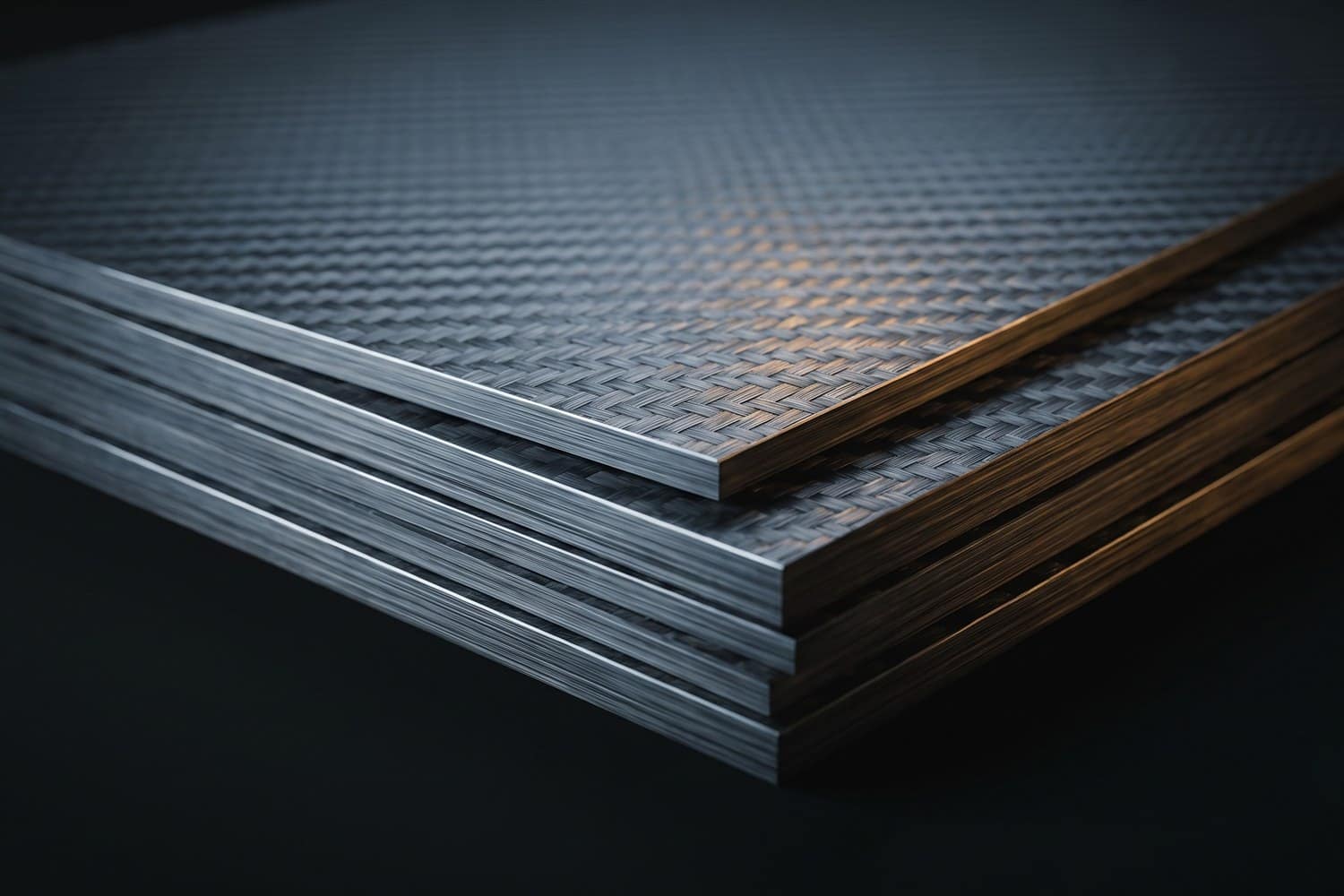
Specification
| Property | Typical value |
|---|---|
| Construction | Laminated, multiple layups |
| Thickness range | 0.25 to 10 mm |
| Sheet sizes | 300 x 300 mm up to 1220 x 2440 mm standard, custom up to 2500 x 2500 mm |
| Layup options | Cosmetic 2 x 2 twill, quasi-isotropic 0/90/±45, unidirectional |
| Fibre grades | T300, T700, T800 |
| Surface finish | Glossy, matte, or twill cosmetic |
Available range
- Standard thicknesses
- 0.5, 1, 1.5, 2, 3, 4, 5, 8 and 10 mm
- Standard panel sizes
- 300 x 300 mm up to 1220 x 2440 mm
- Custom panel sizes
- Up to 2500 x 2500 mm
- Layups
- Cosmetic 2 x 2 twill, quasi-isotropic, unidirectional
- Surface finish
- Glossy, matte, or twill cosmetic
The sizes above are the standard panels. Beyond them, custom sheets, plates and panels are cut to order up to 2500 x 2500 mm. Tell us the finished panel size you need rather than the sheet you expect to cut it from.
What carbon fibre sheet is
A carbon fibre sheet is a flat laminate built from several plies of carbon reinforcement in a cured resin matrix. The plies are stacked in a defined sequence and consolidated under heat and pressure, and the result is rigid flat stock that can be cut, drilled, machined and bonded much like a metal plate while weighing a fraction as much.
Sheet, plate, board and panel are used interchangeably across the industry, and the words carry no technical difference. In general use, thinner material tends to be called sheet and thicker material plate, with board and panel usually appearing in architectural and fit-out work. We quote all four against the same range, so the word you use in your enquiry will not change what you are offered.
What does change the product is the layup. The ply sequence inside the laminate decides how the finished panel behaves under load, how it looks, and how it should be cut and fixed.
Choosing a layup
A cosmetic panel carries a decorative twill on the visible face over plainer structural plies beneath. It is the choice wherever the surface is seen, and the weave pattern and surface finish matter as much as the structural performance.
A quasi-isotropic panel distributes fibre across several angles so the laminate behaves broadly the same in every in-plane direction. This is what you want when load arrives from more than one direction, when the direction is not settled at design stage, or when the panel will be cut into parts whose orientation you cannot control.
A unidirectional panel runs all its fibre along one axis. It is substantially stiffer along that axis than across it, which makes it efficient where the load path is known and runs one way, and the wrong choice where it is not.
If you are not sure which applies, describe the part rather than guessing at a layup. Tell us the panel size, the direction the load runs and how much deflection you can accept, and we will point you at the construction that fits rather than the most expensive one.
Where carbon fibre panel is used
In defence and UAV work, flat plate becomes airframe bulkheads, equipment trays, antenna ground planes and payload mounts, where every gram removed is endurance gained.
In industrial automation, panels are used for robot end effectors, gantry beams and moving carriages, where lower moving mass means faster cycles and less vibration to settle between moves.
In marine and automotive work, sheet is used for structural bulkheads, interior panels, trim and closures, chosen for the weight saving and because carbon is indifferent to salt water in a way aluminium is not.
In architecture and fit-out, board and panel are used for wall cladding, column casings and feature surfaces, where the visible weave is the point and the low weight means the existing substrate rarely needs strengthening.
What to send us when you ask for a quote
A complete enquiry gets a price in one pass rather than three. Send the finished panel size and the quantity, the thickness if you have settled on one, and the layup if you know it.
If the surface is visible, say so, and state the weave and whether you need gloss or matte. If panels sit next to each other and the weave has to line up across the run, that has to be agreed before anything is cut.
Tell us what the part does, which dimension the assembly actually depends on, and whether you need the material cut to size or supplied as full panels for you to cut. Panels larger than the standard sizes are cut to order up to 2500 x 2500 mm, so give us the finished size you actually need rather than working back to a standard panel yourself. If the part is being bonded or fixed through the face, say that too, because it affects what we recommend.
Documentation requirements are agreed at quotation stage, so tell us what your goods inward, your consultant or your customer needs at the same time rather than after the order is placed.
Tolerances and mechanical property data are in the technical datasheet, and confirmed per order and batch.
Where it is used
Aerospace and defence panels
Bulkheads, equipment trays and payload mounts, where every gram removed comes back as endurance.
Automotive
Closures, interior panels and aero surfaces, cosmetic where the weave is meant to be seen.
Industrial automation
End effectors, carriages and gantry plates, so a machine settles faster between moves.
Marine
Structural bulkheads and interior panels, because carbon is indifferent to salt water.
Architectural
Wall cladding, column casings and feature surfaces, light enough that the substrate rarely needs strengthening.
Common questions
Is carbon fibre sheet the same as carbon fibre plate, board or panel?
Yes. Sheet, plate, board and panel describe the same flat laminate product, and the words carry no technical difference. Thinner material is more often called sheet and thicker material plate, with board and panel common in architectural work. We quote all four against the same range.
Which layup should I choose?
Choose a cosmetic layup where the surface is visible, a quasi-isotropic layup where load arrives from more than one direction or the direction is not settled, and a unidirectional layup where the load path is known and runs along one axis. If you are unsure, send the panel size, the load direction and your deflection limit and we will recommend one.
Can carbon fibre sheet be cut to size?
Yes. Panels are supplied cut to your dimensions where needed, or as full panels if you would rather cut them yourself. Standard panels run up to 1220 x 2440 mm, and custom sheets, plates and panels are cut to order up to 2500 x 2500 mm. Tell us which you want at enquiry stage, because it changes how the material is quoted.
Can carbon fibre panel be used outdoors in the UAE?
Yes, with the right specification. Exterior use brings UV exposure, thermal movement and wind load into the picture, which affects the resin system and the surface coating. Tell us the panel is going outside and we will specify accordingly.
How is carbon fibre sheet fixed in place?
Bonded to a substrate with a structural adhesive, mechanically fixed to a subframe with concealed clips, or fixed through the face with fasteners. The method affects the thickness and the edge detail, so it is worth settling before the panels are cut rather than after.
What documentation comes with an order?
Documentation requirements are agreed at quotation stage, so what your goods inward, consultant or customer needs is settled before the order is placed. Every consignment ships with a packing list matched to your purchase order.