
Carbon fibre rods
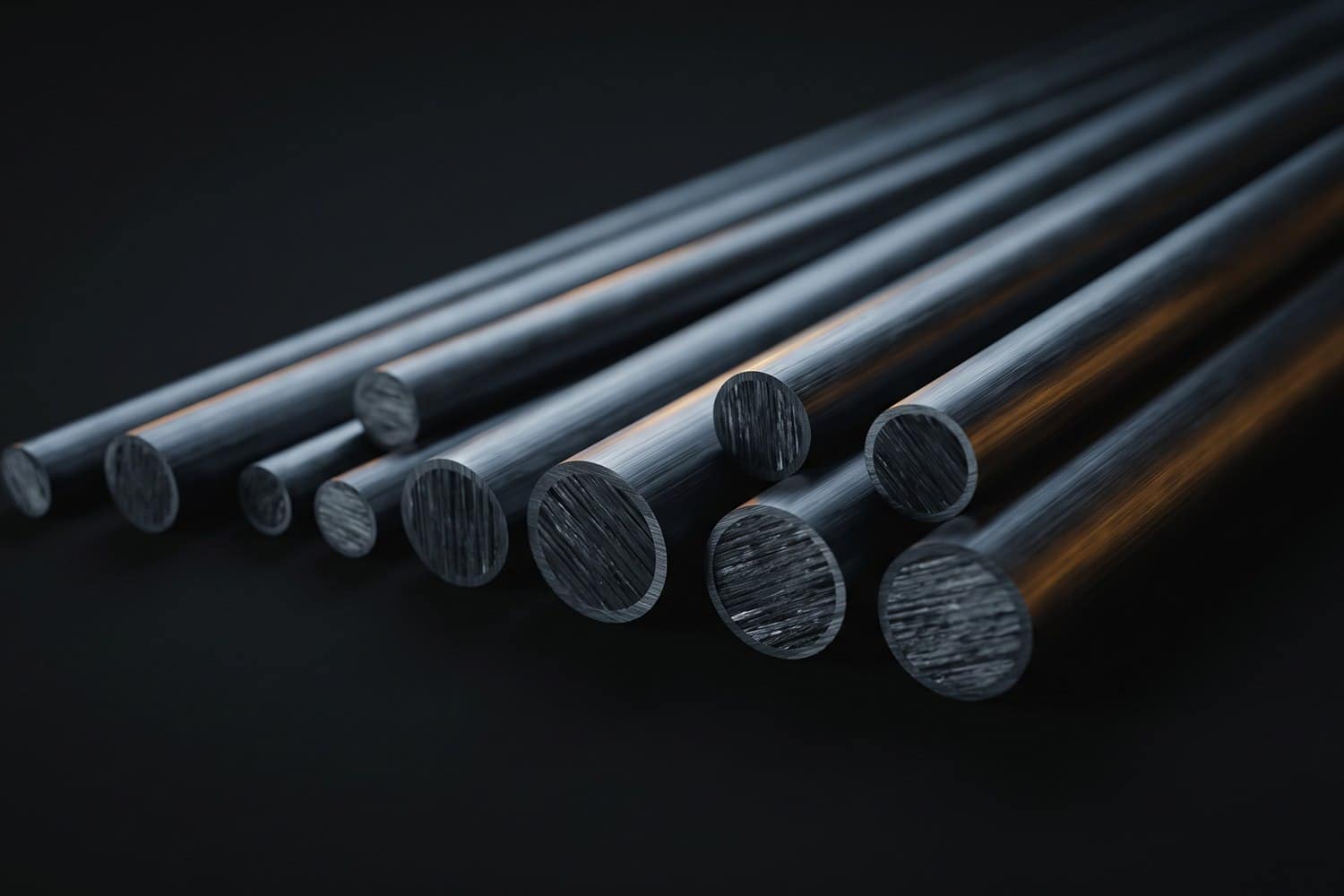
Pultruded solid carbon rods with unidirectional fibre running the full length. Highest stiffness-to-weight of anything in our range, and the reason most customers come to us first. Supplied across Dubai, Abu Dhabi, Sharjah and the wider UAE, with documentation requirements agreed at quotation stage.
Specification
| Property | Typical value |
|---|---|
| Construction | Pultruded, unidirectional |
| Diameter range | 2 to 20 mm |
| Length | Up to 2000 mm, cut to size |
| Fibre grades | T300, T700, T800; high modulus M40J, M55J |
| Resin system | Epoxy, standard, high temperature or toughened |
| Surface finish | Matte sanded, glossy, or peel ply texture |
| Woven finish option | Woven 3K or 12K surface over the pultruded core |
Pultruded construction
Pultrusion pulls continuous fibre through a resin bath and a heated die, so the section is formed in one continuous run rather than laid up by hand. Every fibre runs straight down the length of the rod, which is what gives a pultruded rod its stiffness along its axis, and the die controls the section so the diameter stays consistent from one end of a length to the other.
Choose pultruded rod where the load runs along the length: struts, ties, booms, spars and any member that has to resist bending without adding weight. It is the wrong choice where load arrives across the axis or where you need a hollow section, because all the reinforcement is pointing one way.
Available range
- Standard diameters
- 2, 3, 4, 5, 6, 8, 10, 12, 16 and 20 mm
- Length
- Up to 2000 mm, cut to size
- Fibre grades
- T300, T700 and T800, plus high modulus M40J and M55J
Custom diameters and lengths on request. If your diameter is not listed, ask rather than rounding to the nearest one here.
Tolerances and mechanical property data are in the technical datasheet, and confirmed per order and batch.
Where it is used
UAV and aerospace structures
Booms, arms and spars, where a stiff member that weighs almost nothing is what buys endurance.
Robotics and automation
Light links and moving members, so the machine spends less of its torque accelerating itself.
Marine
Rigging, battens and fittings that sit in salt water without the corrosion problem metal brings.
Automotive and motorsport
Pushrods, ties and linkages, chosen where unsprung and rotating mass is worth paying to remove.
Structural and architectural
Slender ties and bracing that carry load along their length without reading as heavy.
Fibreglass rods
Not every application needs carbon. Where the part is not stiffness critical, or where cost and electrical insulation matter more than weight, a fibreglass rod is often the sensible choice. We supply fibreglass rod alongside the carbon range, quoted and documented to the same standard as the carbon, with documentation requirements agreed at quotation stage.
Common questions
Which fibre grade should I choose for a carbon fibre rod?
Standard grades such as T300 and T700 cover most structural work. High modulus grades such as M40J and M55J buy stiffness at a higher cost and are worth it only where deflection is the binding constraint. Send us the load case and the deflection you can accept and we will recommend a grade rather than the most expensive one.
What is the difference between pultruded rod and a wrapped finish?
Pultrusion pulls continuous fibre through a heated die in one run, so every fibre lies along the length and the diameter stays consistent down a length. A woven surface over that pultruded core is a finish option, chosen where the rod is visible, and it does not change the fact that the structural fibre runs axially.
Can I get a diameter that is not on your standard list?
Yes. Custom diameters and lengths are quoted on request. Ask for the diameter you actually need rather than rounding to the nearest standard one, because the nearest standard size is not always the cheaper answer once you account for what the part has to do.
When is fibreglass rod the better choice?
Where cost or electrical insulation matters more than weight. Fibreglass is supplied as a supplementary line for exactly those applications. If you are weighing the two, tell us the load, the weight target and whether electrical insulation matters and we will point you at the right one.
Is carbon fibre rod suitable for load across its axis?
Generally no. All the reinforcement in a pultruded rod points one way, which makes it excellent along its length and much weaker across it. If load arrives across the axis, or you need a hollow section, carbon fibre tube is usually the better starting point.
Related materials
Further reading
Choosing a grade
If the part is loaded in bending or needs to resist deflection, modulus is what you are buying, so move up the grade table. If the part is loaded in tension and cost matters, T300 or T700 is usually the correct answer. Send us the load case and we will tell you honestly which one you need, including when the cheaper grade is the right call.